
|
It’s Advent!
Which means we have entered the season where I have somehow successfully moved a 50 pound Christmas tree across town and into my house, jigsawed employee Holiday schedules, found a new Advent Wreath for The Hearth, and made it to two friends’ Christmas concerts in a week. It is also the season where I completely forget things, like sending the Church Newsletter, and realize it 6 hours after it was supposed to go out while at the Chiropractor. There is nothing like the feeling of failure when your body reminds you with a crack that you can’t even seem to keep your joints in alignment let alone your Holiday schedule. Does anyone else think it’s a good idea to pile on way too much during the Holidays the same way we think it’s a good idea to pile on food to our Thanksgiving plates? Our eyes are bigger than our stomachs and our schedules are longer than our days. Yet we insist on beating ourselves up about the things that go unfinished on our impossibly long to-do lists. How did we get here when this Season began as an invitation to quiet preparation for the arrival of our Lord? You know, the same Lord who loves us even when we’re the last one to pick up our child at daycare because we underestimated seasonal traffic or we miss an end-of-year report deadline or we forgot an ingredient to make grandma’s Christmas cookies or we don’t get the Church Newsletter out exactly at noon on Friday. This season, I am inviting us into a season of Grace. I am inviting us to remember that Jesus chose to be born into a world full of imperfect people who made lots of mistakes. Jesus’ own parents, who He chose to be His parents when He could have chosen literally anyone, LOST Him for FOUR DAYS (Luke 2:41-46). Jesus chose friends who had questionable pasts, like Mary Magdalene, or who denied Him when He needed a friend the most, like Peter. Jesus loved Thomas, who doubted His most important miracle and Judas, who betrayed Him. This season, we are going to make mistakes, forget things, hurt someone’s feelings, and miss something important. This is what it is to be human, divinely created and loved even when we don’t feel worthy of either. This season, extend grace to others because we are all in this together. When everything goes wrong, when we are royally not our best selves, when someone cuts us off on the highway, when we kind of hate this time of year, remember that you are loved. Remember that you are held. Remember that our God chose to become one of us imperfect beings and die at our hands because He is lavishly, unreservedly, desperately in love with us just as we imperfectly are. And He is so proud to call us His own.
0 Comments
‘Tis the Season…
…for Holiday wars. Are you Team Thanksgiving for the first three weeks of November or are you Team Christmas as soon as Halloween shenanigans come to a close? This is the battle being waged at my workplace right now, starting between two work besties and quickly spreading throughout the building as people take sides hanging Turkeys or Tinsel on their office doors. We are two weeks into November and most employees now have a confusion of decor on their doors, thanks to the Christmas Captain spreading Christmas cheer in the form of tiny Santa hats she has strategically taped onto Thanksgiving doors and the Turkey Top Brass hiding feathers amidst evergreen foliage. But the battle wages on! Despite the friendly competition, we all know that at the end of it all, we all win regardless of Holiday affinity, because our staff have never been more into the Holiday Spirit than they have this year. Holidays are good for the Soul. Holidays are good for the soul because we, as human beings, take after God’s own liking for setting aside sacred time. God, at the start of creation, marked out 6 days of work and 1 day of Sabbath. Holidays invite us into Sacred Sabbath, allowing us to press pause on whatever else is going on around us and take a much-needed breath. During these sacred times, we gather together with friends and family, sharing food and giving gifts. We celebrate generational traditions that remind us of our ancestral Saints who have gone on before us, and tighten the bond we share with the living. We spend time reflecting on our God and all the good the Spirit brings to our lives. Holidays are good for the soul because they are a time to add beauty and wonder to our utilitarian spaces. God, in Her Wisdom, knew the importance of breaking up the mundane and energizing the listlessness of sterile spaces. God, the creator, could have formed a world void of beauty; but instead, He painted flowers across fields and washed color into Sunrises. He splashes vibrancy onto the leaves marking Autumn and whispers a pristine white blanket onto frozen ground. As imago dei, we also love beauty and find ways to add artistic touches around the Holidays to enrich our homes and communities. Holidays are good for the soul because they are a time to disrupt the normal routines and dynamics existing in families and social structures to gather around a point of unity. Perhaps in your family, the kids get to stay up late with the adults on Holidays. Perhaps at your workplace, you get a day off or can leave early. We look forward to these pleasant disruptions, and they remind us of Jesus’ vision for Heaven, where worldly routines and dynamics will be disrupted forever. Where the last will be first (Matt 20:16), the blind will see (John 9:39), the mourning will be comforted (Matt 5:4), and the Kingdom will belong to the Children (Mark 10:14). The Holidays give us a glimpse into the Kingdom of Heaven where all will be brought together as one body, no matter who they are or how they got there. May your Thanksgiving next week be filled with good food and company, an abundance of things for which to be thankful, and the space to reflect on the Divine who wrote into our hearts a desire for Sabbath, Celebration, and a disruption of the status quo. Blessings to you and yours. May your cup be filled that you may overflow the Love of God onto others this Season. One of my deepest convictions about God is that God is larger than our understanding, larger than our language, larger than our culture, and larger than our Churches. I wonder then, if this is why we have such diversity in Christian ecclesiologies. Is the Triune God so large that They cannot be encapsulated into one Church tradition? Is the diversity in our global Christian traditions a reflection of the diversity within God? Avery Dulles, in his book Models of the Church, writes “the Church is not fully intelligible to the finite mind of man, and that the reason for this lack of intelligibility is not the poverty but the richness of the Church itself.” Churches, as a reflection of God, must be intelligible and vastly diverse because God is infinitely above our ability to categorize the Divine.
I think it’s beautiful that there is such diversity because individuals seek different aspects of God and can align themselves with a denomination and church tradition that provides that. Some may find a home in a denomination that is different from our own, and that is okay. Some may find a home in a Church tradition within the same denomination that is different from our own, and that is okay. It is okay because God is good and God is good in all the myriad ways the Divine reflects in us and in our Worship. Personally, I have found my home in a denomination that expounds on the graciousness of God who loves all people, and I find this in the Evangelical Lutheran Church in America (ELCA); and I have found my Church home in a Church outside of Church where people who are uncomfortable within the stained glass windows of traditional churches will find an open table and full inclusion within the muraled walls of a dive bar downtown or a brewery’s music venue. So what does it mean to be Lutheran? The Lutheran tradition finds its pillars in Law and Gospel, which means that we follow the Commandments God placed before us in order to live well in integrity, knowing that our actions impact the world around us - our fellow humans, the animals, and God’s entire creation. God gave us Commandments as guideposts so we would know how to live in mutual harmony with others. God did not give us Commandments with a threat of Damnation. That is where the second pillar comes in - Gospel. Gospel is the Good News that Jesus - through His Incarnation, life, and death - redeemed humanity once and for all. Salvation has been given, and in receiving this gift, we no longer have to live in the shame and fear of being impossibly perfect to prove our worth for eternal Salvation. Forgiveness is an inherent gift of belonging to God, and there is nothing more we need to do to be forgiven. Being ELCA within the greater Lutheran tradition is a call to radical hospitality. Within this tradition, we focus on love, inclusion, and an open welcome to all. We believe that it is not our job to judge who belongs and who does not. We give that right solely to God, and we stand in witness to God’s love, forgiveness, and desire for social justice in the world. This may not be everyone’s cup of tea, and that’s okay too. Wherever you find God, it is my hope that you lean into this relationship and understanding within a denomination and Church tradition that enriches your soul and inspires you to do God’s work in the world - care for the sick, comfort those who mourn, clothe those who are naked, forgive those who have harmed you, fight for righteousness, welcome the stranger, and be a peacemaker in a world that often seems deadset on tearing itself apart. It’s Reformation Sunday this weekend! Don’t know what that is? That’s ok, it's one of those "Lutheran things".
So, buckle up! We have a church history lesson for today’s blog! If you’re feeling more drinky than churchy right now, you can skip the history lesson and scroll down to the section where I talk about my favorite legends about Luther. Who are we as Lutherans and where did we come from? Well, it all started with an (in)famous theologian and monk, Martin Luther, who challenged some questionable Church teachings in the 1500s in Germany. For a long time, the Catholic Church considered itself an intermediary between man and God, and it ascribed to a theology of works whereby Salvation was a joint effort between humans and the Divine. God was ultimately the savior, but the individual still had to do good works in order to earn that salvation. Around Luther’s time, a perversion of theology of works surfaced when Church leaders determined that donating money could be seen as good works. This came to be known as Indulgences (no, not our favorite Castle Church IPA), and the church formalized this process by selling Certificates of Salvation to people for the absolution of their sins or the sins of a loved one. It doesn’t take a rocket scientist to see how this practice favored the rich over the poor and widened the gap between those in power and those not in power. Furthermore, most of the population was illiterate, so they were unable to check the Bible against what those in power were telling them. All of this was deeply disturbing to Luther. Through his own journey, he was beginning to question our ability to work or pay our way to Salvation. He felt he was constantly failing when he attempted to work himself to a place of grace, and he was coming around to the conviction that Salvation may actually be fully a work of Divine Grace. In addition, he was incredibly concerned for the poor in his community, who he felt were being taken advantage of by the Church. So, he did what any good theologian would do and nailed 95 of his ideas about Christianity to the door of a Church in Wittenberg, Germany called Castle Church. His plan was definitely to raise some controversy because his ideas ran counter to what the Church was saying at the time. However, he wasn’t actually planning to create a whole new denomination of Christianity. He just wanted some healthy, public dialogue among theologians to reform the Catholic Church. What he was not anticipating was his 95 Theses spreading like wildfire, igniting a chasm between those loyal to the Catholic Church and those protesting the Catholic Church. This protest eventually became the Protestant religion, and Luther’s theses for reforming the Church began the Reformation, and the Lutheran Church was born. Fast forward 1500 years to the Lutheran Church of today, where we are still reforming theology in the name of Social Justice and creating a Church Community for all, not just a select few in power. Reformation is all about revisiting theology over and over again, ensuring that we are staying as true to Jesus’ mission as we understand it and letting go of all the rest. This is why we are an affirming Church - we welcome all to the table because we understand that Jesus welcomed all, and we let go of our human judgment about who “deserves” to be there. This is why we believe in Salvation through grace - we recognize that Jesus’ sacrifice is enough for our salvation, and we let go of the belief that there is anything we can do to earn it. All you have to know is that you are loved as you are, just as you are. And even if you don’t know that, God loves you just as you are anyway. My favorite legends about Martin Luther (they may be true, who knows!)
This week, around the world, we turn our gaze to The Holy Land. Leaders, both secular and religious, have spoken out about the violence in Israel, Gaza, and the surrounding areas. On Wednesday evening, we as The Hearth, prayed for the countless innocent victims and asked ourselves how we can do better.
Across the world, the global Catholic Church is meeting for their Synod Assembly; and on Thursday morning, they also prayed for the Middle East. One relevant voice in Thursday’s prayers was Margaret Karram, a Christian Palestinian born in Israel and now the President of the Focalare Movement, whose aim is to “contribute to building a more united world in which people value and respect diversity…inspired by Jesus’ prayer to the Father, ‘May they all be one.’ (John 17:21)”. I would like to share excerpts of Karram’s prayer with you today: “Lord, we pray to you for the Holy Land, for the people of Israel and Palestine who are under the grip of unprecedented violence, for the victims, especially the children, for the wounded, for those held hostage, for the missing and their families…In these hours of anguish and suspension, we join our voices to that of the Pope and to the choral prayer of those around the world who implore peace…Help us, Lord, to commit ourselves to building a fraternal world so that these peoples and those in the same conditions of conflict of instability and violence may find the path of respect for human rights where justice, dialogue and reconciliation are the indispensable tools for building peace.” And I would add my own: God of Abraham, may we come alongside our neighbors, regardless of where we position ourselves politically or religiously. May we be peacemakers and advocates for justice. God of the Exodus, may we not fall into the temptation of complacency, where we - safe and secure, fed and sheltered - see suffering glibly as another’s problem and excuse it simply as preparation for individual salvation. May we instead view suffering up close, as an invitation to join with God in overturning tables for justice, feeding the hungry, clothing the naked, and fighting for peace. Amen. Churchers, may you find comfort in these trying times while also responding to the call of discomfort that beckons us into the valley of suffering alongside our neighbors. When I began seminary last month, I heard from a lot of people that seminary is designed to shake your faith. Shake your faith just enough to push you towards deconstructing the unhealthy, unhelpful theology you’ve been raised with and then reconstruct your theology through careful study of trusted theologians and intentional reflection on how these ideas intersect with our world and our internal relationship with the Divine. This week’s deconstruction moment is brought to you by Drs. Jacobson and Elton: “How do we know that the deepest promises of the Bible are trustworthy?”
I’ll be honest, when they posed this question, I was pretty flippant about it. Of course the promises in the Bible are true. Regardless of how we interpret the Bible (as literal and inerrant or as figurative and contextual), I believe that the stories of God’s love through scripture hold true. From a scientific method perspective, God is pretty reliable - God makes a promise with humanity, humanity screws it up, and God shows us faithful love by renewing the Covenant we broke. We see this over and over again in the Scriptures, from God’s promise to Adam and Eve to the promise with Noah and then Abraham and then David. The list could go on. Throughout the Bible, God holds true to the promise written in Deuteronomy 9:7: “Know, therefore, that the Lord your God is God; He is the faithful God, keeping His covenant of love to a thousand generations of those who love Him and keep His commandments.” (NIV). So, we know that God and the Bible are reliable, but are they valid? Yikes. Here’s where the holes start getting poked in my theological understanding. I know God is reliable. I know the Bible is reliable. Both consistently tell the same story of the promises of God and God’s faithful and abiding love. In my own life, I can point to the reliability of God’s love when I consistently turn away from God and somehow God keeps chasing after me. But how do we know the Bible is valid? How do we know that what we are reading in the Bible is true? How do we know that God is true? Theologians have done an insane amount of mental gymnastics to wrestle with these questions and posit an affirmation that yes, the Bible is valid, and yes, God is true. Some have gone the route of asserting that the Bible is an inerrant text as the Spirit-breathed Word of God, and therefore it must be valid because God is valid. Some have pointed to the historical truths that back up the Bible - that the names mentioned in the Bible actually did exist in history, that some of the astronomical events in the Scriptures can be mapped back through science and proven to have happened in the same historical timeframe. At the end of the day, though, these theological discourses may support the validity of the Bible, but what of God? I think the fundamental mistake we make as humans when we are attempting to prove the reliability and validity of God and God’s promises is that we are attempting to use a human tool to capture the Divine. This human tool holds up when we look at Scripture because Scripture is a collection of writings about humanity’s understanding of the Divine. We can measure human work with human tools, but it takes divine tools to measure God; and I’ll let you in on a little secret - we don’t have access to those tools in this life. However, God did endow us with gifts of the Spirit, one of which is faith. I would argue that faith is a spiritual tool more than it is a man-made tool, though it doesn’t quite rise to the level of a Divine tool that can definitively measure God. Faith exists in an intangible way that allows us, at a Spiritual level that cannot be measured, to say yes, I know that God is true and I know that God’s promises are true, even though I cannot prove either through human means. During one of Jesus’ resurrection encounters, He tells Thomas, “Blessed are those who have not seen and yet have believed” (John 20:29 NIV). In other words, Blessed are those who have not been able to prove God through human science and senses yet still believe through the spiritual gift of Faith. It is not naive to have faith in a God that cannot be proven. Rather, our faith is this beautiful, imperfect journey of knowing God; and like any relationship, it ebbs and flows, strengthens and weakens in a way made more honest and trustworthy by the fact that it cannot be measured. God exists above our understanding. God exists above our science. God exists above our reason and rhetoric. How incredible, then, that a God who exists so far above us would love us and choose us, even through our doubts of limited human understanding. This past Sunday we read the second half of Jonah’s story (Jonah 3:10-4:11) as well as the Parable of the Workers in the Vineyard (Matthew 20:1-16). The Gospel message is one I struggle with, but I’ve always loved the story of Jonah; I think because the whole thing is just this outlandish, hyperbolic story of a crazily resistant prophet who keeps throwing tantrums and saying “I just want to die!” and the God who keeps on following after him. I imagine the grandfather, who would gather the families up to tell the grand tale of Jonah, back before any of these stories were actually written down. In the light of the Hearth, this master community storyteller would act out the larger-than-life proclamations of Jonah and the humorous responses of an equally larger-than-life God. We see Jonah called by God to Ninevah to preach against it, but Jonah wanted nothing to do with that, so he boarded a ship in an attempt to run from God. When a great storm comes, he convinces the Pagan ship captain and crew that his God has sent the storm and to throw him overboard. A reluctant and fearful crew do just that, and immediately the storms subsides and they become followers of God, offering sacrifices and vows. Meanwhile, Jonah is swallowed by a whale where he pouts for 3 days and nights before appealing to God’s salvation. The fish then spits Jonah out on land right by Ninevah. So Jonah finally agrees to enter the city, proclaiming the word of God and saving the inhabitants of the city he tried to avoid. And this is where our reading picked up on Sunday. Jonah is in a full blown tantrum against God because he did not think it was fair that Ninevah was saved after all the evil they had done. So Jonah sits pouting just outside the city, and our loving God comes to him, like a parent to a petulant child, and asks him “Is it right for you to be angry?” Then God lovingly grows a sheltering plant above Jonah so that he is comfortable while he thinks this over. However, after a day and night with no response or change of heart from Jonah, God sends a worm to wither the plant and a scorching sun to blaze on Jonah. So, in typical fashion, Jonah falls to the ground with his “let me die'' tantrum narrative. God explains to Jonah his blindspots and asks him if He (God) should not have concern for all the souls in Ninevah. And the story ends with that lingering question! There is no answer from Jonah! I think that just means there is a Jonah sequel. Maybe Jonah was a classic character in ancient stories, and kids would run to the community storyteller and beg for another story of the antics of Jonah. And Jonah would show up in the bellowing voice of the narrator with more examples of our resistance to follow God’s call and to see justice the way God sees justice - as a pathway to spiritual liberation, not human fairness. When we consider this story in light of our gospel reading, we would compare Jonah to the workers who had tended the field all day, and Ninevah to the workers who tended the field just in the last hour - yet they were both given the same. Both are metaphors for a God intent on the liberation of all. This is not surprising in the New Testament, but it does seem out of place in the Old Testament. We tend to see the God of the Old Testament as vindictive, compared to the God of the New Testament, post-cross and resurrection. But Jonah is a beautiful story of the unchanging nature of God, who loved us the same and timelessly. This is a God who saw the people of Ninevah through the lens of the future cross and salvation of all. What we are looking at is a God not of equality, not even of equity, but a God of liberative justice. A God who isn’t trying to make things “fair” through equality - everyone getting different results but the same resources - or equity - everyone getting the same results but different resources. No, we are looking at a God of justice. A God who liberates all of us to enjoy the same results with a new system. This system is not one of retribution (punishment and reward) but one of restoration (healing into right relationship). 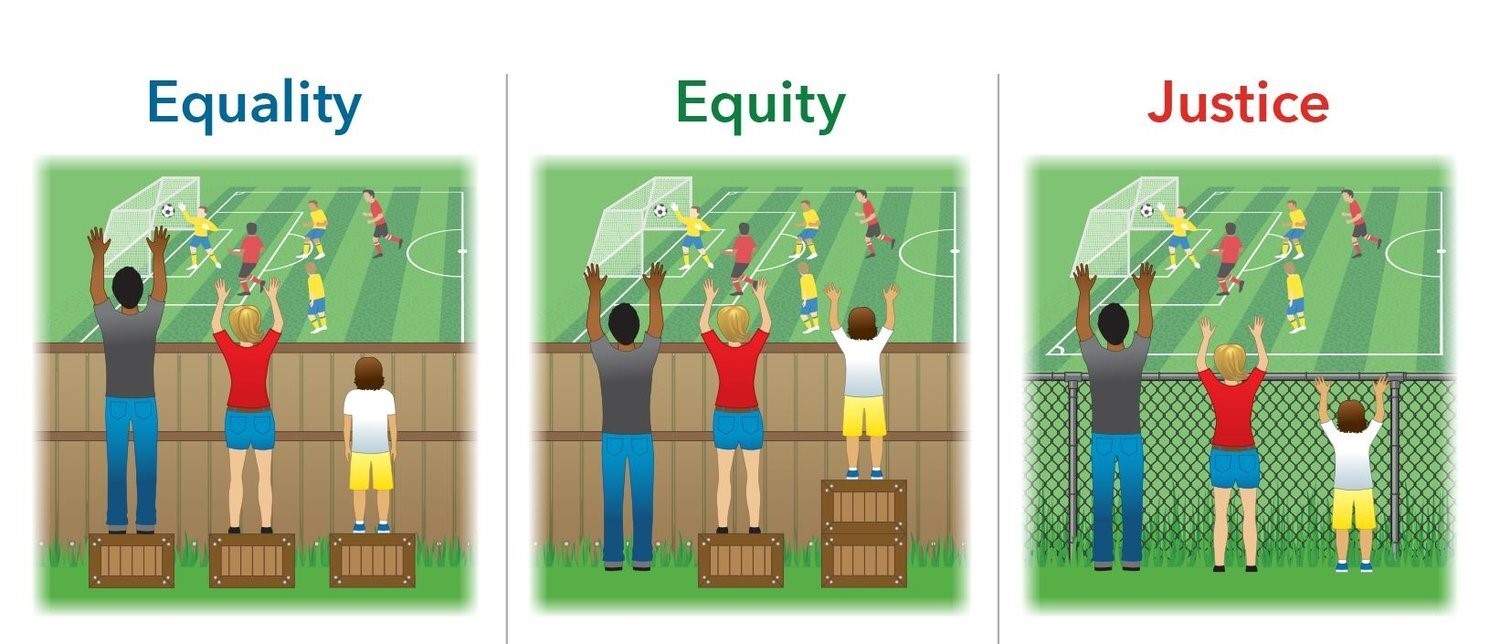 The overthrowing of the old, human system of retribution in favor of the justice of restoration invites all of us, no matter who we are or how we got here or when we got here, to be restored back into the love of God. We have very human, earthly ideas of justice because we want to see someone pay for what they’ve done. But the point of paying for what we’ve done is that we will come out on the other side having paid our dues and be folded back into the community. But eternal damnation does not allow for an end that then folds people back into the communion of God. It is a child’s weak understanding of death because she doesn't understand its permanence. Do we really want someone to not inherit the kingdom of Heaven? Do we really want people to suffer eternally? Because that is the line we stand on when we’re Jonah and wish for the destruction of the city or we’re the worker who doesn’t believe that others should receive the same pay. These are parables, not of our own understanding of earthly justice but of God’s restorative gifts to all humanity. The reframe is critical to reading these stories in the spirit they were intended. The spirit of telling the story of the radical, triumphant, Divine love of God that covers over a multitude of sin to realize God’s true, liberative justice.
This past weekend, a group of friends and I traveled to Crystal River for a Scalloping expedition. It was a beautiful day. The sun was shining, the winds were calm, and we were thrilled to be out on the water with snorkel gear and scalloping nets in hand. About midway through the day, however, dark clouds rolled in, and as we were out in the water the waves began to pick up, and we were suddenly much farther from the boat than when we had plunged in. I consider myself a fairly strong swimmer, but no matter how hard I kicked, I could not close the gap between me and the boat.
To say I was nervous was an understatement. The last time I went scalloping, our boat was caught in a very serious storm that almost caused us to wreck on an island. Come to think of it, maybe scalloping isn’t the hobby for me. In any case, I found myself farther and farther adrift from the boat, but what was so frustrating to me is that the Captain didn’t seem to be doing anything about the fact that his charges were scattered about the radius of his boat, just bobbing around in the lightning storm. So I kept swimming. Finally, I noticed the Captain pull up his anchor and start making his rounds to scoop us up. Calm as can be, he asked each of us as we clambered back on the boat how many scallops we had picked up - like it was no big deal we had all almost drowned! But as I calmed down, I looked out over the bow of the boat, and I realized the waves that looked so terrifying to me while I was in the water, were pretty mundane when seen from the safety of the boat. Through the eyes of an experienced Captain, the storm was nothing to worry about. So often, in the midst of the storms of our lives, all we can do is fear the waves. We struggle against the current, trying desperately to escape an inescapable situation. We cry out to God and ask why our Savior is not saving us. We are unable to see the storm for what it is - a small gall in the midst of the ever changing weather of our lives. But God sees. God knows intimately our joys as well as our despair. We believe that Jesus experienced the depth and breadth of all our suffering, and He knows the gravity of the storm better than we do because He has the privilege of a Bird’s Eye View and an omnipresence transcending time and space. As we are caught in this seemingly endless point of time in our lives, we would do well to remember that eternity is but a breath, and this moment - this horrific, agonizing, terrifying moment - will be as nothing against the glory of God and our union with the Divine. What you are experiencing right now is real and it is deep and it is true. Sometimes we feel that our God is ignoring our pleas, and we wonder if we can trust a Divine who calmly watches us from the safety of the boat. But our God is not a hands-off God. Our God is there in the midst of the storm, captaining the ship, calmly knowing that we are going to weather the storm just fine. And as we finally ascend onto the boat, we will see clearly and no longer through a glass, darkly (1 Cor 13). We will look back over the waves of our lives, some big and some small, and know truly that we were held all along, never alone, never abandoned, never forgotten. We just have to keep on swimming. Almost a year ago, The Hearth leadership held a strategic planning meeting to develop the Mission and Values of our Church. After hours of discussion among leadership and crowd-sourcing from members of our congregation, we decided on the following:
Making space to affirm the Divine in all through intentional community. This statement resonates with us because we value the ways that true community reflects Jesus and His followers. As image-bearers of God, we are called to live into the authentic relationships Jesus created during His time on Earth, and to be known by that love for one another (John 13:34-35). This is especially true for a Church outside of Church. Because we worship in public spaces, we have this amazing opportunity to extend Christ’s love and community to people who would otherwise not experience this. As such, we also have a deep responsibility in knowing that the way we treat each other and the way we interact with people in that public space (staff, patrons, visitors) will reflect not only on our Church community, but Christianity as a whole. For some visitors in our spaces, we are the only positive experience they have had of Church and/or religious people. This is an incredible privilege as well as a sobering responsibility. I am always amazed and humbled when people approach members of our Church to thank them for showing them a vision of God who embodies love instead of judgment, social justice instead of oppression, and acceptance instead of exclusion. This is what it means to create space to affirm the Divine in all through intentional community. This is what it means to be known as followers of Christ by our love for one another. What this does not mean is that you will be judged by how perfectly you act in church. It does not mean that you will be held to a Jesus-level standard of love and community. It just means that we are called to love, respect, show kindness, and be welcoming. We will not do this perfectly (don’t worry, the disciples didn’t either). We will have days that we are not our best selves. However, the beauty of being authentic is that we are real in both our victories and our failures, and we are quick to seek forgiveness and offer forgiveness, knowing that all of us are imperfect beings in need of a Savior and each other. Today, President Biden designated Baaj Nwaavjo I’tah Kukveni (Ancestral Footprints of the Grand Canyon) National Monument, which will conserve nearly 1 million acres of greater Grand Canyon landscape. For decades, the uranium mining industry has fought to gain access to this area, which has been vehemently protected by the advocacy of the Havasupai people, the only local tribe still in residence on that land. Brenda Mallory, Chair of the Council on Environmental Quality, told reporters,
“This land is sacred to tribal nations and indigenous peoples. Its sweeping plateaus and deep canyons share many of the features of the Grand Canyon. The land includes some of the most biodiverse habitats in the region, providing refuge for wildlife like bighorn sheep, bison, bald eagles and songbirds. And the area’s meandering creeks and streams flow into the mighty Colorado River, a critical water supply to millions of people across the Southwest.” I would argue that this land is sacred to all people. Unlike the indigenous people, however, many of us have forgotten how to listen to the Holy Spirit as she flows through nature, begging us to be the stewards of Creation God called us to in His first order to humanity - “Be fruitful and multiply. Fill the earth and govern it. Reign over the fish in the sea, the birds in the sky, and all the animals that scurry along the ground” (Genesis 1:28). In God is Red: A Native View of Religion, Vine Deloria Jr. delves into humanity’s responsibility to stewardship of the land. As part of this, he asserts that the Native People have been called to perform Spiritual rituals in various sacred sites throughout the world. However, due to colonization and infrastructure development, many of these sacred sites are now inaccessible to the indigenous peoples. For centuries, our Native brothers and sisters have been warning that their inability to perform these Sacred rituals will have devastating effects on the world, possibly even hastening the Apocalypse. As Christians, we have this impulse to ignore the pleas of Native Americans by viewing these rituals as idolatrous and inherently against God. We excuse industrialization that prohibits access to these lands by denying the sacredness of these places because they are not inherently sacred within our own religious traditions. But what if they are sacred in our religious traditions? What if we strip away for one second this urge to discount the Spirituality of our fellow people and be open to learning something that could save our world? All of humanity has been ordered by God to reign over the creatures of the Earth. God does not call us to be tyrants; yet somehow that is what we have become - overusing and abusing the planet to the point of devastation. We were made in the image of a God who rules benevolently; therefore, we are called to rule benevolently - protecting, encouraging, and allowing creation to thrive. What if the Native People hold a Divine Wisdom to maintain spaces through their use of these sites as Hallowed ground? In partnering with them to protect lands throughout our world, especially those home to critically important biodiversity, we are uniting in our mission to steward God’s creation towards a vibrant and more sustainable future for all people, all creatures, and all life. |

Kaylee Vance LMFT, LMHC
Worship Leader |
 RSS Feed



|

|
Designed by Evoke Engagement Experts
Proudly powered by Weebly
|